Health and Safety Policy for Tree Surgeon Kingston Upon Thames
 This Health and Safety Policy sets out the standards expected from a tree surgeon in Kingston upon Thames when carrying out arboricultural work. The aim is to protect workers, clients, visitors, members of the public, and property while maintaining a safe, efficient, and professional service. Every task, from pruning and crown reduction to felling and stump-related operations, must be planned with care and completed with a clear focus on risk control.
Tree surgery involves working at height, using sharp tools, handling heavy timber, and operating powered equipment in variable outdoor conditions. Because of these hazards, our approach is built on prevention, assessment, training, and supervision. All work is to be carried out by competent personnel who understand the risks associated with tree work and who follow safe systems at every stage. This policy applies to all employees, contractors, and anyone acting on behalf of the business.
Before starting any job, a suitable and sufficient risk assessment must be completed. This includes identifying hazards such as unstable trees, hidden defects, overhead services, vehicle movement, falling branches, noise, dust, and adverse weather. Where needed, a method statement should explain how work will be completed safely.  The assessment must be reviewed if site conditions change, if a new risk is discovered, or if the work is more complex than first expected.
Safe access to the work area is essential. Barriers, cones, warning signage, or exclusion zones should be used where there is a risk to others. The public must be kept away from drop zones, chipper areas, climbing operations, and vehicle loading points. Good housekeeping is also vital: tools, cut branches, and waste should be managed to prevent slips, trips, and falls. Where traffic or pedestrians may be affected, controls must be in place to reduce exposure.
Personal protective equipment must be worn as required by the task. This may include helmets with chin straps, eye protection, hearing protection, chainsaw trousers, cut-resistant gloves, safety boots, and high-visibility clothing. PPE is the final layer of defence and does not replace correct training or safe working methods. Equipment must be inspected before use and replaced if damaged, worn, or no longer fit for purpose.
 Working at height is one of the most significant risks in tree surgery. Climbers, elevated work platforms, and rope-and-harness systems must only be used by trained, authorised workers. Anchor points, ropes, harnesses, and associated equipment should be checked before each use and maintained according to manufacturer instructions. Where possible, ground-based methods should be considered first, and climbing should only be used when it is the safest practical option.
Safe Use of Tools, Machinery, and Vehicles
Chainsaws, hedge cutters, chippers, stump grinders, and similar machinery must be operated only by competent people. Operators should follow manufacturer guidance, maintain a firm working position, and keep clear communication with colleagues. Machines must be inspected before use, with defects reported immediately and equipment taken out of service if it is unsafe. Guards, emergency stops, and other safety features must never be bypassed or removed.
Vehicles and trailers must be loaded securely to prevent movement during transit. Reversing should be controlled using a banksman or other agreed procedure where visibility is restricted. Fuels, oils, and other substances must be stored and handled safely to reduce the risk of fire, spillage, or environmental harm.  Manual handling should also be planned carefully, with team lifting used whenever loads are awkward, heavy, or unstable.
All staff must receive appropriate instruction, supervision, and refresher training to ensure safe working practices remain current. New workers, trainees, and temporary staff must not carry out tasks beyond their competence. Where specialist work is required, such as technical dismantling or complex rigging, only those with the necessary skill and experience may be assigned. A culture of openness is encouraged so that workers can stop work if conditions become unsafe.
Emergency Preparedness and Incident Control
Emergency planning is a core part of this policy. Teams must know the location of the nearest access routes, safe assembly points, and the steps to take in the event of injury, fire, equipment failure, or contact with utilities. First-aid provision should be suitable for the nature of the work, and at least one competent first aider should be available where possible. Any incident, near miss, or unsafe condition must be reported and recorded promptly so that learning can be applied to future work.
Weather conditions can significantly affect tree surgery safety. High winds, heavy rain, ice, lightning, and poor visibility may make climbing, cutting, or lifting unsafe. Work should be delayed, altered, or stopped if conditions increase the level of risk beyond what can be managed safely. Similarly, trees with decay, storm damage, or structural weakness must be treated with caution and only approached after a careful assessment.
We also recognise the importance of protecting the environment and respecting surrounding property. Waste should be removed responsibly, and work should be planned to avoid unnecessary disturbance to nesting birds, wildlife habitats, and sensitive planting where applicable. 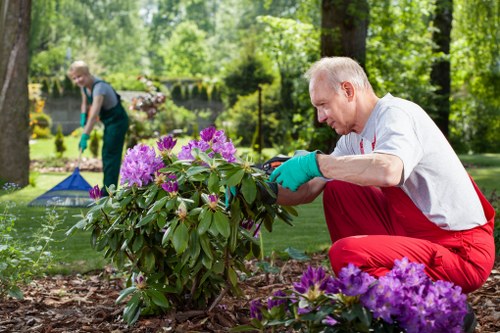 In all cases, the objective is to carry out every tree surgeon Kingston upon Thames service with professionalism, diligence, and a clear commitment to health, safety, and control. This policy will be reviewed regularly to ensure it remains effective, practical, and aligned with safe arboricultural practice.